
Announcing the Winner of the DRI Community Archive Scheme 2026
As a publicly funded repository for Ireland’s social and cultural data, DRI recognises the importance of ensuring that long-term preservation of digital materials is accessible to a diverse range of organisations or individuals, including those with limited or no funding. The creation of community-based archives often relies on the dedication, time, and expertise of individuals or groups working voluntarily or with minimal financial support.
As a result, digital records from community-led archives are often at a heightened risk of loss without proper digital preservation support to guarantee continued access over time. To address this, DRI provides associate memberships, along with all associated benefits, through our Ireland e-Government award winning Community Archive Scheme. These memberships are offered for the duration required for a group to add their collection to the Repository.
The winner of the 2026 Community Archive Scheme is Holly Lennon and the ‘Long Kesh Style’ collection.
About the ‘Long Kesh Style’ collection
‘Long Kesh Style’ is an exclusive collection of historical documents relating to the conflict in the six counties known as ‘the Troubles.’ The collection comprises hundreds of prison letters, communiqués, crafts, and other artefacts. Contributors to this collection include former Long Kesh prisoners, their visitors, and relatives.
The collection seeks to centre the stories of protesting and non-protesting republican prisoners who have been censored politically, historically and in dominant institutional archives. At its heart, this collection is a community-centred project and as such, it relies on material donations from the local community affected.
An example of the types of materials that will be ingested into the Repository include the below photograph of a letter from a prisoner in Long Kesh during the period of the Irish Hunger Strikes (H.S) in 1981:
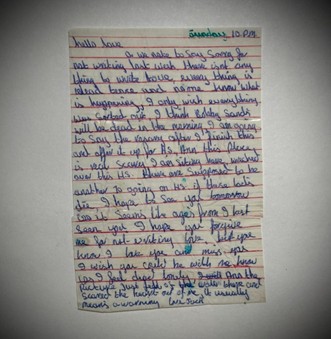
A comms from a prisoner in Long Kesh, stating, “Hello love, a we(e)note to say sorry for not writing last week. there isnt any thing to write love, every thing is dead tense and no one know(s) what is happening. I think Bobby Sands will be dead in the morning. I am going to say the rosary after I finish this and offer it up for H.S. Ann this place is real scary I am sitting here wrecked over this H.S. There are supposed to be another 10 going on H.S if these lads die. I hope to see you tomorrow cos it seems like ages from I last seen you. I hope you forgive me for not writing love, but you know I love you and miss you. I wish you could be with me now cos I feel dead lonely. I will Ann the picture just fell of(f) the wall there and scared the heart out of me, it usually means a warning. Love Jack” (1981)
‘Long Kesh Style’ will greatly interest researchers across various disciplines. The additional contextual and anecdotal information that will accompany the ingested material elevates the collection, as contributors here have the opportunity to reflect on the conflict and provide retrospective accounts from their perspective.
This multi-faceted approach will effectively portray the lived experience and spectrum of feelings related to protesting and non-protesting republican prisoners, and researchers can analyse the material through a post-Good Friday Agreement lens. The collection will include images, sound recordings, and it is hoped that a 3D scan of an ornamental windmill created by a republican prisoner will also be ingested into the Repository.

Holly Lennon is a writer from Belfast. She began collecting assets from Long Kesh prison during the completion of her Master’s degree. She wrote her thesis on Bobby Sands and the 1976-1981 prison protests. Since then, she has accumulated hundreds of artefacts, such as crafts and comms / communiques – small letters from prisoners written on cigarette paper. Holly digitised the collection under the title ‘Long Kesh Style’ in 2024 and uses it to inform the novella she is working on, which focuses on the ‘Blanket Protest’.
Of ‘Long Kesh Style,’ Holly said: “I am delighted with the opportunity to deposit my collection into the Digital Repository of Ireland, particularly as ‘Long Kesh Style’ is dedicated to showcasing aspects of the Troubles that are otherwise underrepresented in traditional archives, including conforming republican prisoners.”
This is the eighth cycle of the DRI Community Archive Scheme. DRI has been privileged to support the memory work of a diversity of community-led archives since its inception, including the Frank Donaldson ‘Tidy Towns’ collection, Folklore.ie; Tulsk History Society; the Asylum Archive; and Dublin-based Community Films by Joe Lee. The collection from Holly Lennon will further expand and enrich the record of Ireland’s digital cultural heritage.
DRI Director Dr Lisa Griffith reflected on the two Community Archive Scheme awardees with the following:
“We are delighted to award the 2026 Community Archive Scheme award to ‘Long Kesh Style’ – a collection that is curated by Holly Lennon. This collection of letters and artefacts from Long Kesh prisoners offers important insights of what it was like for prisoners and their families during this crucial period of the Troubles. This collection shows the hugely important work undertaken by community archivists around Ireland. We are proud to play a small part in helping to preserve these items.’”
For more information about the DRI Community Archive Scheme, please see the dedicated web page.