
Featured archives 2018
ESB Archives
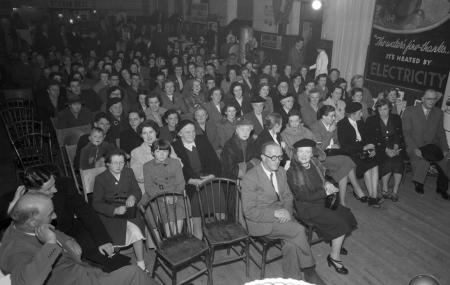
To celebrate Explore Your Archive, ESB Archives have launched previously unseen short films and documentaries commissioned by ESB’s Public Relations Department from the 1920s to the 1980s. ESB Archives film archive offers unique insights into the social, cultural and economic development of Ireland throughout this period.
2018 marked the 90th anniversary of the establishment of ESB’s Public Relations Department. Headed by Ned Lawlor, ESB Public Relations Officer 1928 – 1947, the purpose of the department, described in ESB’s 1928 Annual Report was: ‘to keep the public as fully informed as possible to the Board’s activities’. ESB first dipped its toes in the world of film when they entered an agreement in April 1928 with the First National Pathé Film Company to film Ireland’s first hydroelectric station on the River Shannon at Ardnacrusha, Co. Clare. The film was shown in cinemas, schools and colleges nationwide for educational purposes.
From the 1950s – 1980s many of ESB’s films were produced by the freelance filmmaker George Fleischmann (1912 – 1995). Throughout this period, Fleischmann made c. fifteen films for ESB ranging from films about new power stations to documentaries on rural electrification and ESB’s consultancy abroad, known today as ESB International. The first of the documentaries produced in 1955 by Fleischmann, ‘Power for Progress’, narrated by the broadcaster Eamonn Andrews details ESB’s remarkable contribution to Irish society from its foundation in 1927 to 1955. In addition to footage of ESB’s various hydro, peat and coal stations the documentary provides footage of domestic scenes from the 1950s, the benefits of the all-electric house. Social insights are explored through footage of industrial and commercial activity throughout Ireland. Views of the original Georgian landscape on Fitzwilliam Street provide architectural insights before the re-development of ESB’s Head Office in the 1960s.
On a futuristic theme, the short film ‘Power for Tomorrow’ produced in 1968, explores the countless benefits that electricity has brought to everyday life in Ireland opening with scenes from the air traffic control centre at Dublin Airport. The documentary ‘More Power to the Farmer’ produced in 1957, eleven years into the Rural Electrification Scheme featured the Irish actor John Cowley who later starred in the television series, The Riordans. The documentary details the impactful story of rural electrification throughout this transformative time in Irish history, described as the greatest social revolution in Ireland since the land reforms of the 1880s. The 1961 short film ‘Modern Living Country Style’ filmed at the RDS on the occasion of the Horse Show features the journalist and first female Lord Mayor of Limerick City, Francis Condell demonstrating the most modern country home equipped with new electric appliances transforming the lives of Irish housewives through practical and innovative design. ESB employees were a regular feature in many of the documentaries, in particular the 1972 documentary on Turlough Hill, Co. Wicklow, ‘Peak Power’, dedicated entirely to the workers. It features interviews with the employees who contributed to the largest pumped storage civil engineering project of its time.
For those looking for more detailed technical aspects of engineering projects, the 1977 documentary ‘Poolbeg, Story of a Generation Station’ details the mammoth construction of a generation station and the logistics required. Filmed over a year period the documentary captures significant milestones throughout the project. Footage extends beyond Irish shores, with the 1982 film, ‘Partners in Power’ showcasing ESB’s consultancy overseas, known today as ESB International, documenting electrification projects in Bahrain and Saudi Arabia. Looking towards the future was a common theme throughout the documentaries and the 1984 film ‘Tomorrow’s House Today’ was no exception. A research project based on the construction of six houses in Kilcock, Co. Kildare, the film depicts the planning and construction of the houses, each fitted with various electrical and insulation systems. The results were monitored and analysed by ESB to ensure that the most efficient building and insulation techniques will be used in the future.
To view the on-line film archive please visit www.esbarchives.ie/film
Deirdre McParland, Senior Archivist, ESB Archives.
Tipperary Studies, Tipperary County Council
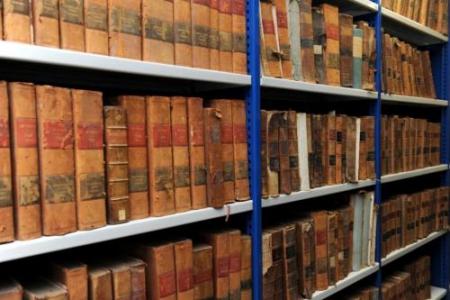
In 1838 the Irish Poor Law Act was passed, introducing a new system of state welfare in the country. Over 100 Poor Law Unions were set up. Each Union had a Workhouse, financed by the payment of rates – taxes on property – on landholders in the Union. The vast bulk of the Poor Law Union (PLU) sources are comprised of Minute and Rate Books. Minute Books contain the records of each weekly meeting of the Board of Guardians – the board entrusted with the administration of the Workhouse – and take account of the finances of the Union, procurement of provisions, hiring of staff, management of inmates and any other issues that may arise as regards the week-to-week running of the Workhouse. Rate Books took account of the occupiers of property and the nature of the property they occupied, and can be very useful genealogical sources.
Tipperary Studies holds records for the following Poor Law Unions Borrisokane, Cashel, Clogheen, Clonmel, Nenagh, Roscrea, Thurles and Tipperary. (please note that Registers for the Workhouses only survive, in part, in Borrisokane, Cashel, Roscrea and Thurles Unions, and Rate Books for Nenagh, Thurles and Cashel Unions);
As part of our digitisation project we have published some of the Registers online. Available to view or download at http://tipperarystudies.ie/digitisation-project/
National Library of Ireland; Seamus Heaney, Listen Now Again Exhibition
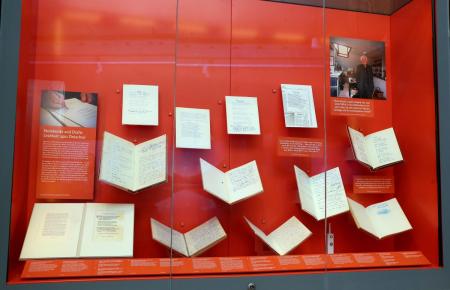
In 2011, Seamus Heaney and his family donated his writer’s archive to the National Library of Ireland, joining what he called a “human chain” of other writers whose papers are at the NLI. Catalogued by archivist Frances Clarke, the collection has been extensively consulted by researchers. Now it has been opened up to an even wider audience, with a selection of the original manuscripts, letters, unpublished works, diary entries, and photographs at the heart of Seamus Heaney: Listen Now Again, the National Library of Ireland’s major new exhibition at the Bank of Ireland Cultural and Heritage Centre on Westmoreland Street.
The free exhibition offers an intimate encounter with Seamus Heaney’s journey, from his childhood in Bellaghy, Co Derry, through to his global renown as a universally admired poet. Exhibition designers Ralph Appelbaum Associates worked with the National Library to display the collection to best advantage, using an elemental colour palette and specially designed individual mounts for each item on view. The manuscripts selected by exhibition curator Geraldine Higgins, Director of Irish Studies at Emory University, show the poet in conversation with himself; revisions and queries scrawled across drafts of his work, appearing on anything from notebooks to the backs of envelopes and loose pieces of paper. More than 100,000 visitors have already visited the exhibition, and been moved and inspired by the story of a writer at work revealed by this fascinating archive.
IBVM (Loreto) Archives
‘….women in time to come will do much…’
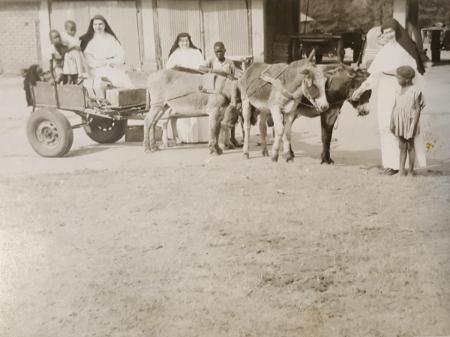
These are the words written by Mary Ward, founder of the IBVM religious order in the 17th century, more commonly known as Loreto. Her prophetic words are as relevant today as they were 400 years ago. Her words have challenged and inspired generations of Loreto women to respond to the social and humanitarian needs of their time. Sr Rita Garica IBVM was one such respondent. A native of Spain, she joined the Loreto mission in South Africa in 1918 and in 1929, with two other Loreto Sisters arrived at the remote Catholic Mission of Glen Cowie (South Africa) determined to meet the needs of the local communities. Living in the isolated mission and ill equipped for their work, the Sisters travelled on foot visiting homes and villages, providing pastoral and health care.
Recognising the urgent need for health care, Sr Rita embarked on an informal medical career, travelling on her rudimentary cart pulled by two donkeys aptly named ‘Peter’ and ‘Paul’ to visit and later to transport the sick, especially children, to the missionary clinic in Glen Cowie. Sr Rita garnered a reputation for her medical ability, particularly in dentistry, and queues of patients soon formed for her attention! In 1935, she was formally appointed to oversee the management of a new eight bed clinic, and in 1942 was appointed first matron of a new 60 bed hospital; which was renamed St Rita’s Hospital in her honour. During her years as matron she oversaw the establishment and development of a nurse training unit and the progression of the clinic from a rudimentary four roomed clinic to a large, modern hospital. By the early 1960s services offered by the hospital had expanded to include general hospital care, maternity services, paediatric services, surgical theatres and a TB isolation unit. In 1977 the hospital was handed over to the government of Lebowa, fulfilling Mary Ward’s aim of empowering and enabling women, and the wider missionary aim of building independent and sustainable local communities. St Rita’s hospital continues today as a government hospital and a training facility for medical professionals.
Sr Rita died in 1964, and her funeral was attended by ‘over one thousand people’. Guards of honour were formed by the ‘nurses and other staff members of St. Rita’s Hospital, Jane Furze Hospital and the pupils of Guardian Angels’ College, reflecting the deep bonds she had built with the local community. Over 35 years of inspiring ministry in Glen Cowie, Sr Rita Garcia IBVM embodied Mary Ward’s prophetic words that ‘women in time to come will do much’.
Explore the IBVM (Loreto) ministry in South Africa and the inspiring ministries of women who devoted their lives to the prophetic vision of Mary Ward, that ‘women in time to come will do much’, at IBVM (Loreto) Archives, 55 St Stephen’s Green, Dublin 2; https://loreto.ie/history/loreto-archives/, or our online catalogues through the Irish Archives Resource (search for ‘Loreto’ on www.iar.ie website).