Featured archives 2020
RCPI
Online Exhibition: “The Most Terrible of All the Ministers of Death”: Smallpox and the introduction of vaccination to Ireland
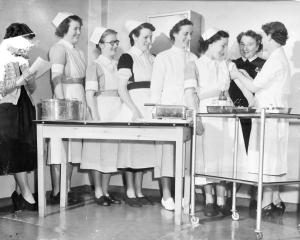
The first recorded vaccination in Ireland took place in 1800 against smallpox, then one of the most serious infectious diseases known. This exhibition explores the discovery of the smallpox vaccination, its introduction to Ireland and how the authorities rolled out the programme of vaccination, and where and when it was opposed. It also looks at contemporary vaccination in Ireland and why, in a time when there are numerous safe vaccines against a number of serious infections which have saved millions of lives, there has been a rise in anti-vaccination sentiment.
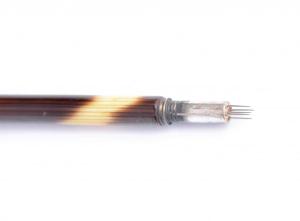
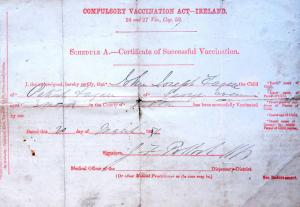
Detail of a 19th vaccinator and a certificate of compulsory vaccination, 1871
Visit this extraordinary online exhibition here.
NUI Galway
Digital Collection: Genevieve Lyons Archive
This digital collection is a series of material from the archive of theatre actress Genevieve Lyons, primarily between 1948 and the 1963. Based in Dublin, Lyons’ career was mostly with the Globe Theatre Company, founded by Godfrey Quigley, Michael O’Herlihy and Dennis Brennan. Lyons also starred at other theatres including the Gate Theatre, Dublin, and the Pike Theatre on Herbert Lane. Lyons was born in Dublin on 5th of March 1930. Throughout her acting career in Dublin, Lyons consistently won acclaim for her performances and as a leading member of the Globe Theatre Company. The Globe performed primarily new international plays, as well as Irish plays, and provided Dublin audiences with a diverse new range of theatre and culture, from their base at the Gasworks Theatre, Dun Laoghaire.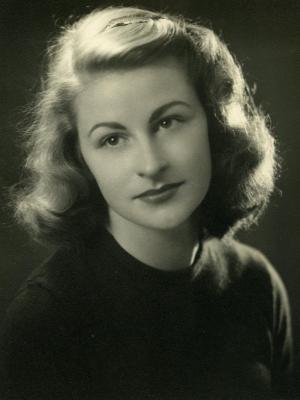
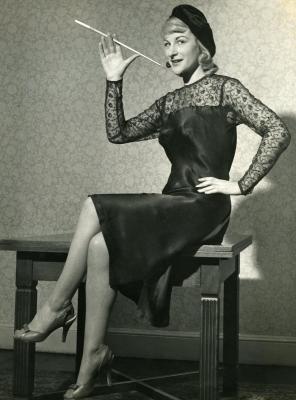
Lyons was a central member of the Globe Theatre Company. Founded by Godfrey Quigley and others including Michael O’Herlihy and Dennis Brennan, the Globe was an independent theatre company established in Dublin in 1954 as “a unique experiment in the Irish theatre”. The company sought to create a space outside of the urban centre of Dublin city for professional theatre. The first play presented by the company was the American funeral parlour comedy, “The Biggest Thief in Town” by Dalton Trumbo (1954). Based at the Gas Works Theatre in Dun Laoghaire, the Globe Theatre Company regularly performed on major stages such as the Gate Theatre, the Olympia Theatre, the Gaiety Theatre and were frequently part of the annual Dublin Theatre Festival. The group specialised in international theatre, as well as Irish plays, and premiered many new international works for Irish audiences.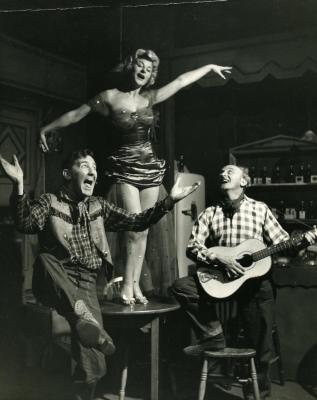
Key performances by Lyons include the role of Marion in the Irish premiere of J.P. Donleavy’s stage adaptation of his novel “The Ginger Man”, famously censored and shut down after three performances in 1959, owing to pressures from the Archbishop of Dublin, John Charles McQuaid; Lydia Lubey in Arthur Miller’s “All My Sons” at the Gate Theatre, 1954; Christine in Gabriel Marcel’s “A Broken World”, 1959; and as Sally Bowles in John Van Druton’s “I Am a Camera” which was seen by over 15,000 people at the Gas Works Theatre in Dun Laoghaire in 1956.
For more information on the Genevieve Lyons Digital Collection see here.
Royal Irish Academy
Online Exhibition:
Creative Women of Ireland: Artists and Writers from the archives
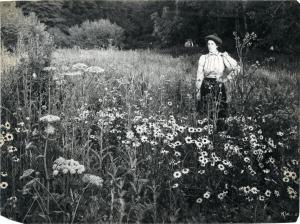
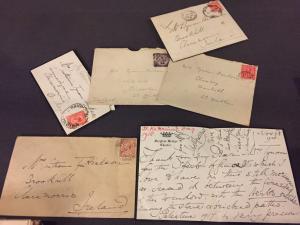
From little known artists to well-established writers, this exhibition turns the spotlight on creative women from the Academy’s archives. Explore the lives of Sophia Rosamond Praeger, Eileen Barnes, Mary Fitzpatrick, Mia Cranwill, Lady Sydney Morgan and Katharine Tynan
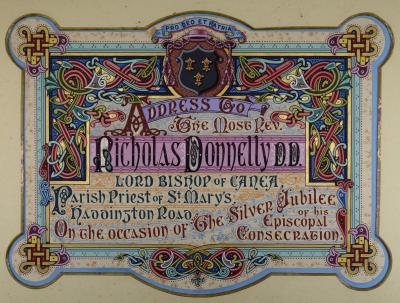
Address to Rev. Nicholas Donnelly DD, Lord Bishop of Canea, Parish Priest of St Mary’s, Haddington Road, Dublin on the occasion of the silver jubilee of his episcopal consecration. [Dublin, 1908]
The full exhibition can be viewed online here.
Military Archives, Cathal Brugha Barracks
Online exhibition: Niemba Ambush Anniversary
On the 8th November 1960, while serving in the Congo as part of a United Nations peacekeeping mission, a patrol of 11 men were ambushed by Baluba Tribesmen. 9 were killed. The men were part of “A” Company, 33rd Infantry Battalion.
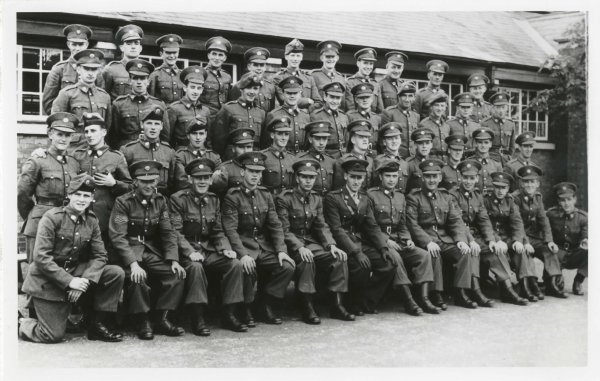
The 33rd Battalion were deployed to the Republic of Congo in August 1960. They were the second Irish contingent to serve overseas in this capacity. A post was set up in the village of Niemba in October and Lt Gleeson and his platoon were ordered to command it. On Tuesday 8th November, 1960 Lt Gleeson was accompanied by 10 members of his platoon on a patrol which made their way towards Kinsukulu. The men were ambushed at a broken bridge on the River Luwuyeue by a large group of Balubas.
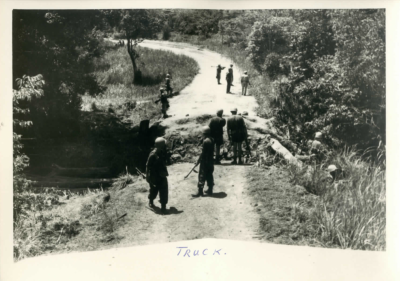
After the patrol failed to return, a search party was organised at Battalion Headquarters and reinforced by troops at Niemba. In the days after the ambush, 8 bodies were found. These were identified as Lt Gleeson, Sgt Gaynor, Cpl Dougan, Cpl Kelly, Pte Fennell, Pte Killeen, Pte Farrell, and Pte McGuinn. Tpr Browne’s remains were found 2 years after the ambush. Pte Fitzpatrick and Pte Kenny were the only survivors. This exhibition provides information on the ambush, the search patrol sent to recover the bodies, the operation to apprehend injured Balubas involved in the ambush, and the impact at home.
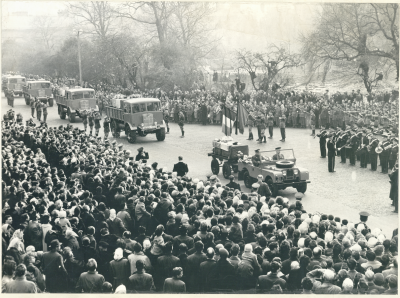
The online exhibition, curated by Archivist Linda Hickey can be seen here.
Military Archives, Cathal Brugha Barracks
Online exhibition: RIC Dismissals and Resignations during the Revolutionary Period
The Committee of Enquiry into Resignations and Dismissals from the Royal Irish Constabulary (RIC) was appointed on the 28th November 1922 by Mr Kevin O’Higgins, TD and Minister of Home Affairs. The Committee was required to investigate cases where members of the constabulary resigned or were dismissed from the RIC between 21 January 1919 and 11 July 1921 because of their nationalistic sympathies.
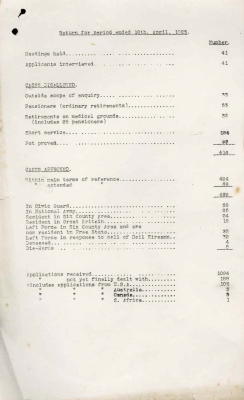
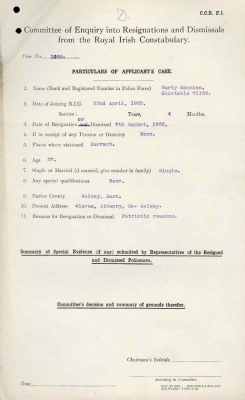
“Part of the interim report of the Committee- statistics on applications received” “Example of an application form – MIPR collection”
Material in this exhibition is taken from the MIPR Collection (Military Intelligence and Press Analysis, Civil War), and Colonel Thomas Gay’s private collection. The exhibition provides information about the applications, the work of the committee and committee member, Colonel Thomas Gay. In civilian life, Gay was a Librarian and during the War of Independence, was part of Michael Collins’ intelligence network.
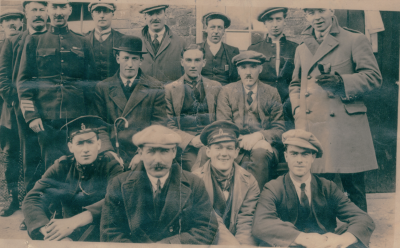
The online exhibition, curated by Archivist Lisa Dolan and Archives Volunteer Gerry McCann (retired Sergeant, Air Corps) can be seen here.
Tower Museum, Derry / Londonderry
Online Exhibition: The Patrick Maxwell Diaries

These incredible diaries tell the story from the viewpoint of Patrick Maxwell, a solicitor who lived in East Wall, Derry at the turn of the 20th century. He traveled to the United States and Canada on multiple occasions, documenting the experiences on board a transatlantic journey and noting the emigrants around him in great detail.
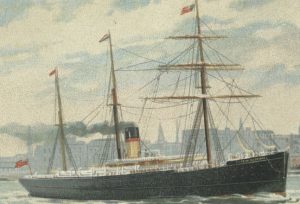
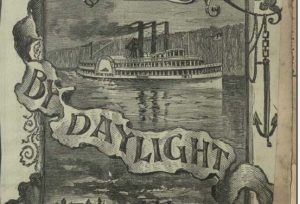
Images include views the voyages as published in the Derry Journal, as well as a series of newspaper cuttings on goings on in the town around this period.
For more information click here.
Tower Museum, Derry / Londonderry
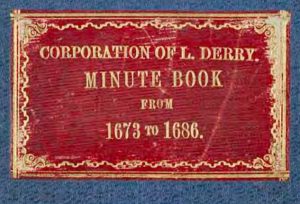
Online Exhibition: Londonderry Corporation Minute Books
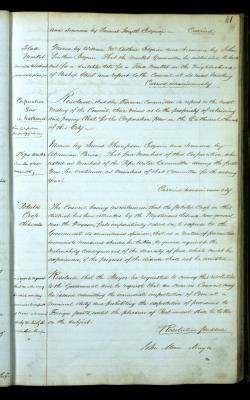
Londonderry Corporation Minute Books have now been digitised, in a joint digitisation project with PRONI, and are available to view online. Each minute book begins with the date of the meeting of the Common Council and a list of those members in attendance. In the late 17th and 18th centuries, the city’s business life consisted of merchants and craftsmen such as butchers and bakers, tailors and shoemakers, smiths and saddlers, joiners and coopers.
The Corporation leased out the quay, the cow market, the general market (and collection of tolls), the mills and the ferry. The main market was in the Diamond and the Corporation settled a scale of market fees.
Clongowes Wood College Archive
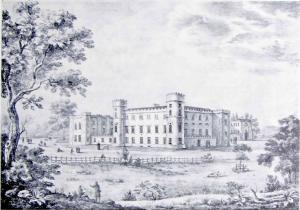
History and development
Clongowes Wood College SJ has a long and rich history of education in Ireland since it was founded in 1814 by Fr Peter Kenney SJ. It was the first work of the Society of Jesus worldwide following its restoration that year after 41 years of suppression. The college was located outside of Dublin to avoid affront to the British authorities as the Penal Laws remained in force and constraints on Catholic Education were many. The chosen location was a historic one on the line of The Pale and there had been castles on the site since 1450. The new school occupied the relatively modern 18th century version with the entire community of Jesuits and students living in the same building.
Notable past pupils
For more than two centuries, the college has produced many notable alumni including leaders in business, politics, social justice, sport and the arts. Graduates of the college have gone on to become leaders in Ireland and the Jesuit project was encapsulated in one man in 1914, when Old Clongownian, John Redmond was on the brink of becoming the first Prime Minister of Home Rule Ireland. Other prominent past pupils range from the author James Joyce (part of whose novel A Portrait of the Artist as a Young Man is set in the school) to Thomas Francis Meagher, Michael Joseph ‘The’ O’Rahilly and Kevin O’Higgins.
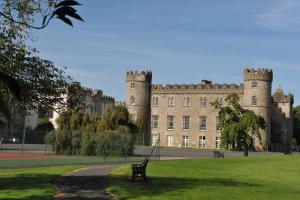
The College and Castle today. The windows of the archive may be seen in the bottom left hand corner of the castle building
The Archival Collection
The collection comprises papers, visual materials and artifacts relating to the history of Clongowes since its foundation. There are bound volumes of handwritten records from the 19th and early 20th centuries as well as school attendance and examination records, books of account and diaries. There are also copies of various prospectuses as well as all issues of the school annual, The Clongownian, a valuable historical resource, which has been published since 1895. There are photograph albums, VCR tapes, DVDs, maps and floor plans/sketches for building projects.
The collection also includes materials from the collections of various previous owners, when the buildings and grounds as well as items donated by various Jesuits and Old Clongownians. There are also some artifacts of both a religious and a personal nature including an original school uniform and glass plates of overhead photographs taken from a kite.
The collection is divided into eight series:
- The history and involvement of the Jesuit Community both in the school and its hinterland.
- Materials relating to the purchase of the property and the development of the many buildings that have arisen as the school has developed.
- The governance of the college and the Jesuit Community.
- Jesuit Ethos in the school and its perpetuation in their potential absence.
- The changing nature of education in the school from the initial classical approach to the modern points based system.
- Indoor co-curricular activities such as debating, drama, music and academic presentations.
- Outdoor co-curricular activities including athletics, football, cricket, tennis and golf.
- The financial stewardship of the school from income in the form of fees, government grants and bequests to capital and current expenditure.
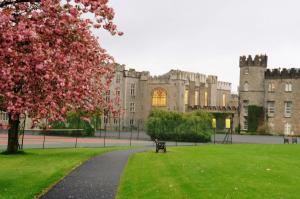
It is the intention of Clongowes, in tandem with the Irish Jesuit Province and its proactive approach to access, that the collections in the archive be made known and be as available as possible. In normal times the archive is available to researchers by appointment (045 -868202) on Tuesdays and Thursdays (09.00-17.00) during the academic year, but other days (and times of year) are possible by arrangement.
Declan O’Keeffe, Assistant Archivist and College Historian; Editor, The Clongownian
Wicklow County Archives
Shillelagh Workhouse Records
The admission and discharge registers of the Shillelagh Union workhouse date from 1842, just before famine times. These are perhaps the most poignant records at Wicklow County Archives, illustrating the suffering of the poor in the lists of names of those admitted to this institution.